being a student, books, Reading, Reading Identity

Lessons in Genre—and in Failure

We have been studying genres in 3rd grade.

Something so simple, and yet such a powerful key to unlocking yourself as a reader. For some students, these classifications are crystal clear; they already have the language that wraps around them as readers. For others, the designations are murky at best—confusion between fiction and nonfiction (which I completely understand in this day and age), and even what it means for something to be a genre at all.

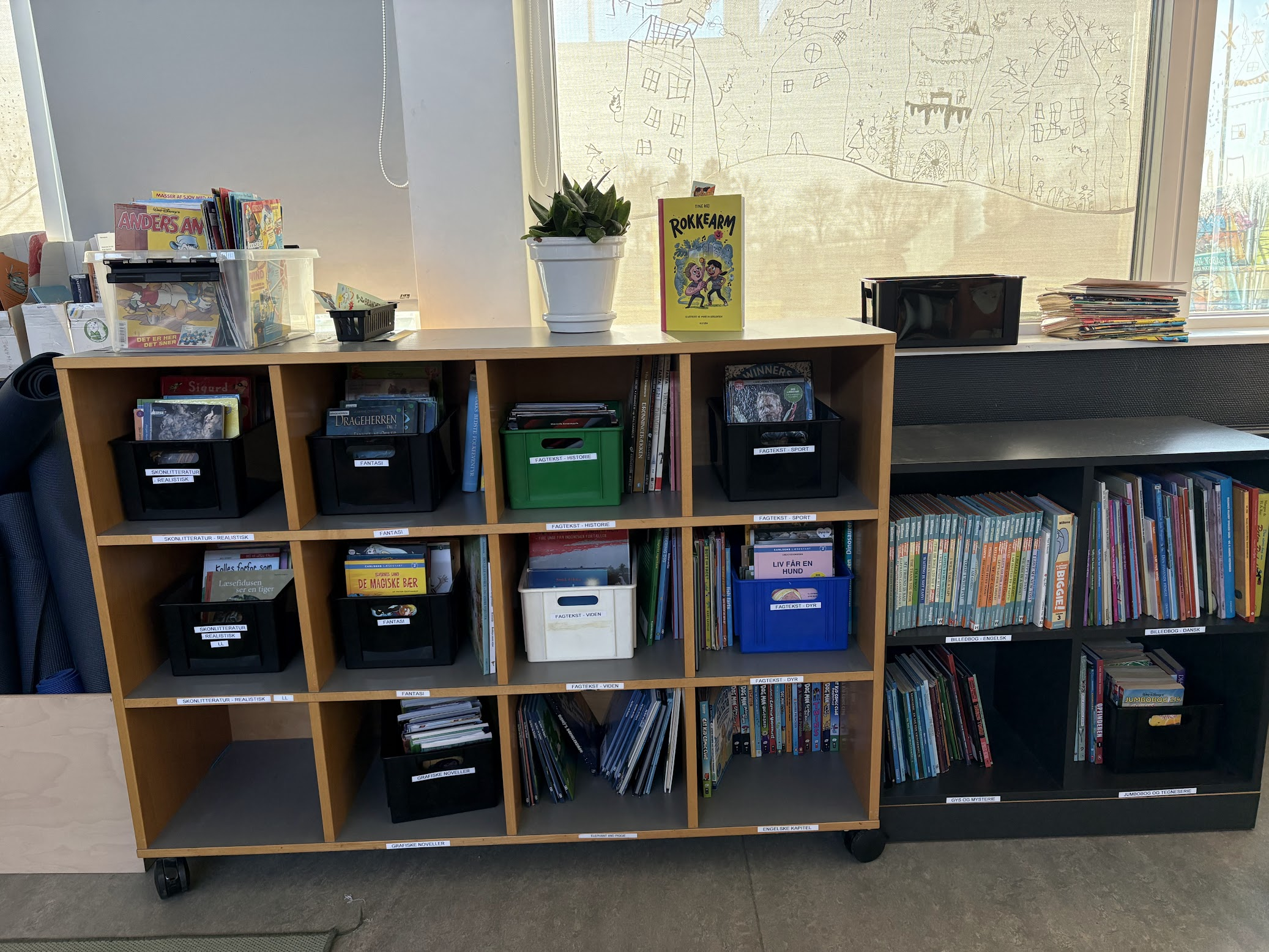
It’s also a practical challenge: how do we turn a messy classroom library into something students can actually navigate? Sorting books by genre is a powerful way for students to deepen their understanding of different types of texts and make the library itself more accessible. It is something I have believed in for years.

And so, we persisted in the work. We sorted texts and discussed what makes something realistic fiction, fantasy, horror, or nonfiction. What separates fantasy from a scary story? How do we know realistic fiction isn’t just fantasy in disguise? Their questions were legitimate, and they shaped the work we did.

To truly see their comprehension in action, we turned to our modest classroom library. Those who have followed my work from before my move to Denmark may remember my vast classroom collection—books spanning walls, even rooms. I left that library behind for the teacher who took over my classroom, knowing it would have more use in the United States than it would here.

But that also meant starting over.

Books in Denmark are expensive—often more than 200 kroner (around $20) even for an easy reader. Classroom libraries are not seen as a priority. School libraries aren’t either in some places. So building a collection has been slow, relying on goodwill finds, donations from our amazing librarian and some families, and a few contests won along the way. It is nothing impressive. It may never be. But it is real, and it reflects the reality of many educators.

And it is a place to start.

I teach two 3rd-grade classes in Danish: one I have been with since 1st grade, and another added this year. With my “old” class, the task was simple. After our genre lessons, I introduced the project: let’s sort and categorize our classroom library using the knowledge we now have. We decided on which genres and even subgenres we thought we would have, discussed their abbreviations and then launched into the process itself; I would hand them piles of books, they would sort them by the genre or format they believed they belonged to by creating piles on tables, I would create labels, and together we would shelve them.

It took two lessons, but by the end our classroom library was mostly sorted correctly, and the students were eager to dive back into books they had discovered along the way.

Buoyed by this success, I brought the same process to my new class. I knew they might need a little more guidance, but surely my well-planned lesson would be successful.

It was not.

It was frustrating, confusing, and messy—and through no fault of the children. They tried their very best to figure out what we were doing and to do it well, as they always do. But the pieces they needed simply weren’t there yet.

So I took time over the weekend to think it through and quickly recognized my mistakes. They needed far more scaffolding. They needed the work to stop feeling like a competition over who could get through the most books. They needed to lean on each other for guidance. They needed explicit permission, as always, to ask questions and to not be sure out loud.

On a day when I knew I had them for three periods in a row, I knew we could afford to get messy. I reintroduced the concept and explained the new plan.

Two students, who seemed to have genre determination skills firmly in place, sat at the lead table. Their job was to decide whether a book was fiction or nonfiction and to venture a guess at its genre or format (graphic novels and comics were sorted onto their own shelf). They passed their books to three other students, who double-checked the decision and delivered them to the appropriate genre table. Each genre table was staffed by a student whose job was to agree—or disagree—and send the book back if needed.

I placed students based on their perceived strengths within a genre. Some worked alone. Some sat near related genres so they could support one another. And then we began.

At first, there was hesitation. Were they really sure that a certain book belonged in a certain genre? How could they even tell again?

But as the process continued, their confidence grew. Their decisions became more certain. Help was offered more freely. It was still messy. It was still a bit chaotic. But the process worked.

Not because I taught it better—but because I reconsidered my scaffolding. I reconsidered the conditions. I stepped away from my own attachment of feelings to a lesson—failure—and recognized that this, too, was success: realizing, once again, what didn’t work and adjusting the conditions., with the only failure being to not do it again.

In the end, this wasn’t really about genres, or even about sorting a classroom library the “right” way. It was about slowing down enough to notice where my teaching had raced ahead of my students, and choosing to meet them where they actually were. Understanding didn’t come from efficiency or speed, but from time, conversation, and the safety to be unsure out loud.

The messiness didn’t disappear when I changed the structure.

The noise didn’t go away.

But what did change was who carried the thinking. Students leaned on each other. They questioned, disagreed, and revised their ideas together. And in that space, comprehension began to take root.

We now have a tiny little classroom library, where the gaps in what we don’t have are stark, and yet the hope of finding books to read feels big. Students get to look at the bookstacks and decide which books to keep and which to let go.

It’s a small piece, but one that further cements their identity as readers—students who now know that if they understand the genres they enjoy, they can seek out those books first. Students who have taken a big step toward knowing who they are, and perhaps even more importantly, who they want to be as readers.

It may have taken longer than expected. It may have veered off course. But those hours spent were hours I know were worth it.

So for now, the reading continues.

Passionate Readers, Reading, Reading Identity

This Is the Work

This week, I was invited to sit down with with Dr. Sarah Sansbury, Leah Gregory, and Janette Derucki for the Can’t Shelve This podcast (releasing February 10th). The invitation was simple: come talk about reading culture. About what we actually do in our classrooms and schools that either invites children into reading or quietly pushes them away.

That kind of conversation is my favorite. Not because I have the answers, but because I am still in it. I am still trying to build something that works for the kids in front of me. Much like so many others, I wonder if what I am doing is actually making a difference.

And as we kept circling those ideas, this kept rising to the forefront for me:

We can’t make readers. But we can create the conditions where they might want to be.

That really is the work.

Not forcing reading.
Not rewards.
But building spaces where children feel safe enough, curious enough, and seen enough to want to read.

That’s the heart of it.

Because so often, when we talk about getting kids to read, the conversation turns to compliance. Comprehension work. Logs. Levels. Programs. Points. Prizes. Proving that you are reading. Proving that you understood. Proving that you are a reader to begin with. More minutes. More data. More pressure.

And yet, none of those things create readers. Not really.

They create performers.

If we want reading to matter, then the culture around reading has to matter. The environment has to say:

You belong here.
Your choices matter.
Your pace is respected.
Your identity is not up for negotiation.

But before we can build better conditions, we have to look honestly at what we already have. Do we even know what the reading culture is in our spaces or do we just assume?

So some questions I use to take the temperature:

  • Who is reading in my room? Only the kids who already love it?
  • What kinds of books are visible? Do they reflect the kids in front of me? Do they reflect the world?
  • What happens when a child says, “I hate reading”?
  • Is reading something they do, or something they only are told to do?
  • Are students trusted with their own reading decisions?
  • Do I celebrate growth, or just volume and level?
  • Who shapes our reading experience the most?
  • Do they even feel like readers? And how do I know?

And then we get to work.

So we go back to the basics, that are really not so simple after all.

We protect choice.

Not “choice within a level.”
Not “choice after you finish this.”
Just…choice.

Let students pick what they read, when they abandon a book, and what kind of reading feels meaningful.

Because identity grows in the places where we feel trusted.

We build book collections that reflect the world.

Keep adding. Keep weeding. Keep listening to what they reach for. And we fight to protect those choices.

We remove reading as a punishment or somethng that always has to be proven.

No logs.
No always answering questions.
No reading “to earn” something. If reading only happens because they have to, then they never get to discover that they might want to.

We talk about books like they matter. Because they do.

And we protect the time to read. We would never go to math class and not actually practice math, so why are we told to limit independent reading.

Share what you’re reading. Share when you are reading, when you are not. Tell them what reading helps you with.
Let students share what they’re reading.
Have conversations, not quizzes. Protect independent reading time for all.

Make reading social, human, and alive.

And we make it safe to not be a reader yet.

Students need to know:
You are not behind.
You are not broken.
You are not failing.

You are becoming.

That is the only way they stay open long enough to grow.

It’s not flashy. It doesn’t come in a box. It doesn’t produce instant results.

But it honors students as readers in progress, not readers we are trying to manufacture.

Because the work is not about getting kids to read.

It’s about creating spaces where reading feels possible.

And then staying in that work, every single day. Even when the world tells you to stop. Especially then.

Be the change, being me

One breath at a time

I have the lung capacity of a 70-year-old.

Several years ago, I was diagnosed with a genetic deficit in my lungs and liver. One that can lead to emphysema, asthma, and a whole list of other things no one hopes to casually collect. It made sense. Walking up the stairs while talking would leave me breathless, still does. And yet, hearing that my lungs were not the way they were supposed to be was a quiet devastation. One more heavy thing to carry. A moment where my imagined ending shifted, where my future suddenly looked smaller, more fragile, than I had planned for.

And then we did what people tend to do.

We carried on living.

I noted how biking uphill became harder, how running became officially impossible (not that it was ever my thing), how nearly every cold turned into bronchitis or pneumonia, how exhaustion lingered long after the illness had passed. How my body kept whispering, something isn’t right, even when I was trying very hard not to listen.

And my fear grew. Because living beside your own mortality, really beside it, is exhausting. It’s scary. It makes you feel out of control.

A year ago, I realized I needed to change the trajectory. That I was living inside a self-fulfilling prophecy of decay. Because I knew biking would be hard, I didn’t bike. Because I knew exercise would leave me gasping for breath, it did, and once I was out of breath I stopped. I avoided the very things that might help because they confirmed everything I was afraid of.

But I also knew this: the constant current of stress, needed an outlet. And sugar wasn’t it. Alcohol wasn’t it. Tears weren’t it. Rage definitely wasn’t it.

A change had to come.

So I signed up for an introduction to CrossFit, bought actual trainers, and showed up — wildly out of my depth, unsure of what I was doing, and hoping no one would notice how hard breathing felt. I didn’t do it because I suddenly believed in myself. I did it because staying the same felt worse.

What followed wasn’t a transformation. It was resistance.

It was showing up fueled more by desperation and anger than motivation. It was loud, angry music. It was the fear of being the first to die in a zombie apocalypse. It was learning that I will never like running, or be good at it — and that this does not mean I can’t do it.

It didn’t come from a big training program. It came from small steps. From doing a little, resting, and then doing a little more. From learning that my pace is not a failure, but a necessity.

My pace. My way.

How much of change is exactly this?

Not the sweeping programs. Not the inspirational speeches. But lacing up your shoes (I promise this won’t turn into an exercise blog) and seeing how it goes.

So on January 1st, I made the goal that I wanted to be able to run one kilometer in a month. I turned to ChatGPT and asked it to create a plan. Its first suggestion was to warm up by running three kilometers.

And I couldn’t stop thinking about how familiar that felt.

How often do we ask for a small change and are handed an overhaul? A new program, new training, new language — when what we really needed was permission to start where we are. To try one thing. To begin without confidence, without mastery, without pretending this will be easy.

I see this all the time in education. We want to support children better, reach them sooner, help them regulate, belong, and learn. And so often, the answer becomes more: more systems, more steps, more expectations, more work for the adults — while the children wait for us to fix everything.

And then we wonder why we burn out.

Because the truth is, we cannot meet every child’s need. And that expectation, implicit or explicit, is impossible to carry alone. What we can do — what truly matters — is show up. Notice. Offer presence, consistency, and a small, safe step forward. For some children, just knowing that someone sees them, waits for them, or trusts them to make a choice is enough to shift something inside.

The children carrying so much anger, fear, grief, and overwhelm spill it into our shared spaces. They trust us enough to bring all of that mess into school — even when we cannot fix it.

This work rarely starts with big interventions. It starts with the smallest possible step. Not because it will fix everything, but because it might shift something, and because we, too, need to survive alongside them. And so we start small.

Letting a child decide when a check-in happens — now, later, or not today — and trusting that choice as information, not defiance.

Creating one predictable question that never changes, not to extract answers, but to signal safety: Do you want me close, or do you want space?

Making the exit plan visible before it’s needed, and then honoring it without commentary when it is used.

Lowering the academic demand in the moment without lowering the relationship — fewer words, shorter tasks, a pause instead of a push.

Offering literacy as regulation: a book already on the desk, a familiar text reread, writing without an audience, reading without assessment.

Naming what you notice without asking for repair: Something feels heavy today. I’m here when you’re ready.

Returning to the child later, always later, to restore, not resolve.

It is allowing yourself to not be perfect. To say good enough. To try, live with it, and then, when it becomes familiar, add another layer. It is resisting the urge to rush toward resolution and choosing presence instead.

This is slow work. It is unglamorous. It is deeply human.

And maybe that’s why we miss it while it’s happening. Because change rarely announces itself.

And like taking small steps with your own health or fitness, it is done one breath at a time.

Today, I ran 2.6 kilometers. That’s 1.6 miles for those of you in the U.S. A new personal record. Something I didn’t think I could do a year ago, and not even a week ago.

And maybe that’s the point. Change, for me, for a child, for a classroom, doesn’t announce itself.

It slips in quietly, one breath at a time.

So do we keep breathing? Or stop?

being a teacher

Quiet, ordinary, enough

I’m on my second cup of tea of the day.

Waiting for my husband to come home so I can head out into the world with our youngest, giftcards burning a hole in her pocket.

We woke up in the dark, but knowing that we gained 5 minutes of sunlight already. We lumbered into awakeness through pages read, quiet conversation, and a plan for this second to last day of the year. A plan that will inevitably change, much like it always does.

We continued at the kitchen table, laying out hopes and dreams for the year to come but also reflecting on the year past. We are walking into 2026 with gratitude, dragging our tired bones behind us, but also reveling at the strength that sometimes comes from just surviving the challenges that were embedded in our lives.

2025 will be remembered for some of the darkest days I have had as a parent, searching for answers in how to give a child hope enough to last into the next day. Leaving my home not knowing what I would come home to. Waking throughout the night and wondering whether someone is truly okay or just pretending and whether the tomorrow we wake into becomes a break in our timeline, the before and the after.

But we didn’t.

And so I continue to seek out the ocean as I winterbathe tellling myself that I am okay. That we are okay. And I walk into 2026 with this in my head. I am okay. We are okay. Reveling in the little moments of calm. Of my second cup of tea looking out into my frost covered garden, waiting for the sound of nearly all teenage feet to inevitably stumble into the kitchen demanding my attention.

Our lives are lived in these moments.

In quiet contemplation, in quiet joy that is right there detectable but only if you look. In late night movies, in pages turned, in situps and pushups (nearly anyway), in marveling at the stars although we have seen them so many times, in the taste of a well-cooked meal. In a child waking up for one more day with the fortitude and strength to continue living. In getting dressed and heading to spaces where we get to be part of the quiet joy of other peoples lives. Where for a moment we can help others feel seen, feel understood, and feel like being there, together, actually does matter.

Some of the children we teach are not striving. They are surviving. And on some days, so are we. It is a truth rarely spoken out loud, tucked beneath the language of goals and growth, beneath the expectation that learning must always look like progress. And yet, sometimes the most meaningful thing that happens is simply that someone returns. That they show up. That they choose, once again, to be part of the day.

At its heart, education is not about fixing what is broken. It is about being there. About becoming one of the quiet, steady places in a life that may feel anything but. A pause, a familiar routine, a story that asks nothing in return. About recognizing that survival is not a failure of ambition, but often the bravest work being done.

And so we show up. Not because we have answers, or because presence will solve everything, but because it matters.

Because sometimes what carries us forward is knowing that someone will notice if we arrive, that there is a place where we are expected, where we can sit for a while and simply be. Our lives, and our classrooms, are made of these moments. Quiet, ordinary, enough.

balance, Be the change, being me

The Work That Still Works

It has been ages since I have written here.

Not created content, not shared ideas, but simply written in the ways that I have been writing for so many years. A familiar refrain, a coat that fits just so, but left forgotten in a closet because who has time to take it out?

It seems I moved to Denmark and forgot parts of myself.

As with so many other things, there are many reasons. We moved back home, but home was something brand-new. I had to create a support system for everyone in the move, which also included two of my children receiving neurodivergence diagnoses that finally made so many things make more sense. I had to learn how to be a teacher in an education system that I have only ever been a student in.

And so I put my head down, and I took the steps every day, trying to get all the pieces to fit together, even though the instructions never came, and the pieces seemed to change overnight.

And I ran, and I felt I couldn’t share because what we navigated was too hard at times, too raw, too foreign—even though it shouldn’t have been—and I knew I would have found solace in sharing out, but also felt that this story was one that had little importance, while the world we had left behind seemed to light on fire. And it didn’t feel new or worthy, because the whole world is filled with glitz and glam, and influencers telling you that they indeed hold the key to happiness.

But now, I am here. Back in this space, still holding hope that there is a space to return to.

Because the work is still there. The need to shout for more sanity, to slow down, to get back to basics, even though there are so many forces that work against us.

And so we take the basic steps every day to retain dignity, to further understanding, and to create spaces where children get to be fully human.

This year, I took over a parallel 3rd grade, a bunch of incredible kids who, through circumstances beyond them, have had a slew of incredible teachers who haven’t been able to stay. And so, rightfully so, they demand a lot of the adults who now get to be their teachers, because why should they trust us to stay when so many others have left?

And so we have done what we have always done: we have slowed down. We have integrated morning meetings every day, we have reclaimed independent reading. We have taught conflict solutions for them to use before they come to us. We have talked, and talked, and talked—but not at them, with them—giving them ways to voice their worries, their hopes, and their ideas. We have differentiated the work, given them more freedom to move, to shape their learning, so that they too can answer how they learn best.

And I have wanted to share about all the progress that we have built, but is there really a way that something as simple as starting with a morning meeting, and how simply asking children to hold space for each other’s voices, can help another educator out there?

Because it is not flashy. It is basic. And it is being pushed out of our schools at alarming speeds, replaced with more learning, more rote, more prepackaged programs. And in this rush, we forget that gathering in schools is also meant to simply gather us. And when so many of our children gather more and more behind a screen, they don’t know how to gather on the floor unless we make the spaces for it.

Unless we hold on to the value of it.

Unless we stand steadfast and refuse to let the invented urgency of more curriculum drown out our common sense.

And so we plan for it, because we see the inherent strength of asking others to listen, to set their needs aside while others speak, to wait their turn, and then know that when they do speak, others do the same.

And so, I sit in the light of my soon-to-be taken-down Christmas tree, and I recognize the need for simplicity. For recognizing and owning that I don’t want to create simply to produce. That what works for me still works. Basic, down-to-earth ideas that may not be flashy or glitzy, but at their core recognize the humanity of the children we teach.

And so, for now, I am here. I will share. I will hold space for those of you who are also running every day, who also feel that what you are doing is maybe not the flashiest of work, but Lord knows, it works. And we see it in the way the kids carry themselves. How they ask us whether we can do a morning meeting when our schedules are changed. Who want to share all the things they have been holding in. Who come to school knowing that when they are not there, they are truly missed.

Perhaps I was missed too, here. I am not sure, but I know I missed this.

student choice

The Thinking Classroom in ELA

Next week, in my 3rd grade Danish class, we’re starting something new — or maybe something old, just done differently.

We’re bringing the Thinking Classroom to our literacy work. I have seen the excitement from it in math, which made me wonder; how can we model the same concept but within ELA (or DLA in my case 😊).

So in true Pernille fashion, I asked if anyone was interested in seeing the slides with prompts I had made in either Danish or English, and it turned out that, yes! Many were interested, thus this blog post. I’ve made about 40 slides filled with open-ended prompts — things that make kids talk, think, argue a little, and notice patterns together. They’ll work in groups of three at whiteboards with pens in hand, no right answers in sight.

Some prompts are silly. Some are uncomfortable. Some might just stay half-finished on the board — and that’s fine. The goal isn’t to finish, it’s to think.

We’ll spend 15–20 minutes at a time exploring ideas like the rules of horror, what truth really means, or how emotions might have colors. The work will shift with them — from laughter to silence to something that feels almost like discovery.

I can’t wait to see what happens next week when we start.

If you want the Danish slides, join my Facebook group: Læselyst i Danmark.

If you want to try it too, I’ve shared all of the Thinking Classroom slides here — take what you need, change what you want, and see where your students take it.

Let me know how it goes.